Tuesday, January 16, 2007

Dreams Do Comes True


I love this story from our friends at BUONGIORNO VENEZIA - The News from Venice (published weekly by VENICEWORD INTERNATIONAL MEDIA SERVICES). I took the photo in May 2004. Click on the photo to enlarge it and check out the broom the sweeper is using. They're handmade (I once got lost and came across a place where a sweeper was putting his broom together) and have probably had the same design for centuries.

The story reminds me of the Jimmy Buffett song, "It's my job..."*


Here's the article:

The dream of Federico Bastianelli, a street cleaner in Falconara Marittima (a little town in the Marches region in the centre of Italy) came true at dawn on 6 January. Last September, he made a wish, hoping to be able to clean St. Mark's Square, and the councillor responsible for the environment granted it. At 5:30 a.m. on 6 January, together with a team of Venetian colleagues, he began his work shift in front of the timeless splendour of the Basilica and of the Doge's Palace. "I love my job in Falconara," Federico says, "but to do it in Venice is beyond comparison." At 10:30 a.m., the end of his work shift, AIPE (Association of Commercial Businesses) offered him a toast, and Federico, beaming with joy for having accomplished his greatest wish, was only able to say: "I am very happy."

Congratulations to Federico.


* "In the middle of late last night I was sittin' on a curb
I didn't know what about but I was feeling quite disturbed
A street sweeper came whistlin' by
He was bouncin' every step
It seemed strange how good he felt
So I asked him while he swept

He said 'It's my job to be cleaning up this mess
And that's enough reason to go for me
It's my job to be better than the rest
And that makes the day for me.'

"It's My Job," by Jimmy Buffett, from his album Coconut Telegraph (1981)

Monday, January 15, 2007

YouTube in Venice

Given my weakness for webcams (I like to watch), I'm not sure exploring YouTube was a good idea. but, it's fun nonetheless! Go watch a bunch of homemovies about trips to Venice....

"Venice Italy 'In a Nutshell,'" is my favorite so far. Got a favorite Venice video? Let us know.

Wednesday, January 10, 2007

John Singer Sargent's Venice Paintings Coming to NYC


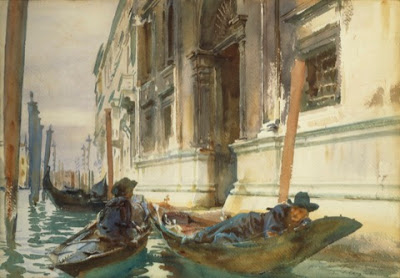
The painting is John Singer Sargent's Gondoliers' Siesta, c. 1904. Next week, an extensive exhibit of Singer's Venice paintings opens in NYC. From there, it goes to Venice. Here's an excuse to visit Manhattan (as if you should need an excuse!).


From the Adelson Gallery website:

SARGENT’S VENICE, A SPECTACULAR ARTIST’S VIEW OF THE FABLED CITY, TO BE SHOWCASED IN A TRAVELING EXHIBITION TO OPEN IN JANUARY 2007 AT ADELSON GALLERIES IN NEW YORK CITY

New York, NY (Autumn 2006)—John Singer Sargent (1856-1925), one of a few truly international artists of the 19th century, had a love affair with Venice: He traveled there numerous times over 40 years. Adelson Galleries in New York, noted for its expertise in American art and the work of John Singer Sargent in particular, has organized an exceptional loan exhibition, Sargent’s Venice, comprising approximately 60 oils and watercolors painted by the artist from the 1880s until 1913. The exhibition will be on view at the gallery from January 19 through March 3, 2007 and then will travel to the Museo Correr in Venice—marking the artist’s first-ever solo exhibition in that city—where it will be on view from March 24 through July 22, 2007.

Sargent’s Venice will be organized as a journey down the Grand Canal, following the artist’s route from a gondola perspective and examining his choice of viewpoints and compositions. A majority of the paintings to be shown are on loan from private collections and have rarely been on public view; several institutions, including the Brooklyn Museum, Philadelphia Museum of Art, The National Gallery of Art in Washington, D.C., the Royal Academy of Arts in London, and the Museo Thyssen-Bornemisza in Madrid, are loaning important works as well.

Inspired by the idea of idea of retracing Sargent’s routes down the Venetian waterways, Warren Adelson, president of Adelson Galleries and the sponsor of the Sargent catalogue raisonné, saw this approach as a means to gather together the Venice pictures that appear throughout several volumes of John Singer Sargent: The Complete Paintings (Yale University Press). “We had decided to write about John Singer Sargent's years of painting in the city that he most loved, and realized that in his long career and in the intervening years after his death in 1925 that there had never been a one-man exhibition of his work in Venice,” Mr. Adelson said. “Sargent's Venice will showcase the range of his painting in oil and watercolor over a span of forty years. It will be the first such exhibition in New York (Adelson Galleries) and, remarkably, the venue at the Museo Correr in St. Mark's Square in Venice will be the first exhibition of Sargent ever held in that magical place.”

John Singer Sargent was born in Florence to American parents and lived most of his adult life in England. Widely recognized as the preeminent portrait painter of his generation, he felt equally at home in Europe and the United States where he painted many of the most notable social and political figures of his day. When Sargent felt the need to escape the demands of his portrait commissions, he traveled to Italy and Switzerland with friends and family to paint (usually out-of-doors) whatever appealed to him. Of the many places he visited over the course of his long career, the allure of Venice surpassed all other destinations and it is where he produced some of his most evocative and masterful oils and watercolors—many painted while sitting in a gondola.

Featured in Sargent’s Venice will be not only pictures of beloved Venetian scenes, such as the Rialto Bridge, the Doges Palace and Santa Maria della Salute, but also scenes of traditional Venetian life including intimate glimpses captured of the interiors of wine shops, residents strolling along the streets, women at work stringing beads, café settings, and more. Among the most recognizable works to be seen will be The Sulfur Match (1882), Gondolier’s Siesta (1905) and Street in Venice (ca. 1882).

Adelson Galleries is uniquely qualified to present the artist’s work in this context. In 1980, Warren Adelson, an internationally recognized authority on Sargent, initiated scholarship on the John Singer Sargent Catalogue Raissoné in partnership with the artist’s great-nephew, Richard Ormond. To date, four volumes of the Catalogue Raisonné have been published by Yale University Press; Volume IV was released in October 2006. The gallery has also made significant contributions to the study of American art through critically acclaimed loan exhibitions and accompanying publications including Art in a Mirror: The Counterproofs of Mary Cassatt (2004-2005), Sargent’s Women (2003), Maurice Prendergast: Paintings of America (2003), From the Artist’s Studio: Unknown Prints and Drawings by Mary Cassatt (2000), Childe Hassam: An American Impressionist (1999) and Sargent Abroad: Figures and Landscapes (1997).

Assisting Mr. Adelson in organizing Sargent’s Venice is Elizabeth Oustinoff, director of Adelson Galleries and co-author of Sargent Abroad. A fully illustrated accompanying book of the same title will be published by Yale University Press in January, 2007, with essays by Mr. Adelson and Ms. Oustinoff as well as by Richard Ormond, co-author of The Complete Paintings of John Singer Sargent (Yale University Press) and former director of the National Maritime Museum in Greenwich, England; Elaine Kilmurray, research director of the Sargent catalogue raisonné project and co-author of The Complete Paintings of John Singer Sargent; William H. Gerdts, professor emeritus of art history at the Graduate Center of the City University of New York and author of highly respected articles and books on many aspects of American Impressionism; and Rosella Mamoli Zorzi, professor of Anglo-American literature at the Università Ca’ Foscari, Venice, and co-curator of the exhibition Gondola Days: Isabella Stewart Gardner and the Palazzo Barbaro Circle, organized by the Isabella Stewart Gardner Museum in 2004 as well as the author and editor of several publications.

On January 17, a gala benefit evening will be held from at Adelson Galleries for Venetian Heritage, Inc., a not-for-profit organization based in the United States whose mission is to encourage and support artistic and intellectual initiatives and cultural exchange between the United States and Italy; to safeguard the Venetian cultural heritage as manifested in architecture, music and fine arts, in Venice and its former dominion; to sponsor exhibitions, lectures and conferences intended to stimulate interest in the urgent and never-ending needs of Venice; and to familiarize people all over the world with the problems of the city. Patron tickets are $150 per person/$300 per couple and Benefactor tickets are $250 per person/$500 per couple. For more information about this special evening, please call 212.439.6800.

Adelson Galleries is open to the public Monday through Friday, 9:30-5:30, and will be open on Saturdays during this exhibition from 10-5. The galleries are located 19 East 82nd Street, New York, NY. Tel: 212.439-6800. Fax 212.439.6870.

Sunday, January 07, 2007

When Murano Beads Ruled the World

Visitors to Venice often succumb to the lure of Murano glass. Few of us realize that the shiny glass beads once were of vital interest all over the world. I was rooting around in the New York Times archives and stumbled upon an article which was originally published on November 30, 1917.

Bead Supply Is Menaced.
Invasion of Italy Affects the World-wide Monopoly of Venice.

Washington, Nov. 27.--The menace to Venice from the Austro-German campaign [of World War I] in Northern Italy strikes sharply at one line of trade in which the whole world is interested. It is the trade of glass beads. Venice is the bead capital of the world. In the South Sea Islands, the heart of Africa, under the North Pole, Tibet, Patagonia, at the uttermost corners of the earth will the handiwork of the Venetian artisan be found. In this country tons of beads from Venice find their way into the handiwork of our Sioux, Chippewa, and Five Tribe Indians.

Harvey Carroll, American Consul at Venice, in a dispatch just received by the Department of Commerce, says that the Venetian bead-making industry is a monopoly and controls a world-wide exporting business, shipping to Africa, India, Oceania, Asiatic countries, Europe, and the Americas. It makes the beads that are used as money by certain tribes in the Congo and in German West Africa, and ships many thousands of tons of bead ornaments to the savage as well as the civilized nations of the world.

The offices of the company are in a magnificent old palace at Murano, the Palazzo Trevisan, which boasts frescoes by Tiepolo. The foundries and factories cover many acres of ground. Before the outbreak of the European war this company kept in storage more than 4,409,245 pounds of manufactured beads. At the present time less than one-fourth this quantity is in stock, and production has greatly decreased, owing to difficulty in securing fuel and raw material.


While exploring, I found the Venetian Bead Shop, which has some interesting information on blowing glass beads and other information. I know nothing about them, but if you're interested in Murano
beads, this could be a place to start.

A friend (thanks, Marie) sent me a link to Prairie Edge, which claims to have the " last and the largest collection of Italian glass beads (over 2,600 different styles and colors) from the same Venetian guild that supplied fur traders in the 19th century. The Societa' Veneziana Conterie closed its doors in 1992 and Prairie Edge acquired all the remaining inventory, over 70 tons in all. View exquisite examples of finished Plains Indian beadwork. Most of the beads on display are offered for sale in Sioux Trading Post." How the collection wound up in South Dakota is not explained.

Monday, January 01, 2007

Sad News to Start the Year


<span style="font-weight:bold;">This has nothing to do with Venice, but I wanted to post it anyway.


Our house and our hearts are empty tonight. Gretel, the retired Seeing Eye dog who lived with us for the past two and a half years, died suddenly today (she would have been 12 next month). Last month, she passed her physical with flying colors. This morning, after her walk and morning treat, she collapsed. Never losing consciousness, she remained fully aware. We rushed her to the animal hospital and learned she had massive abdominal bleeding brought on by cancer. Instead of prolonging her life with painful treatments, we let nature take its course and, tearfully, let her go.

We didn’t have Gretel for long, but each moment was wonderful. She was a great ambassador for the Seeing Eye organization. She was a beautiful girl and strangers would often stop us to ask about her. When we told people about her working life as a Seeing Eye dog, people were fascinated.

At first, Gretel was serious, no doubt trying to figure out what her new “job” was supposed to be. Soon, she figured it out. Her job was to get petted whenever possible! She turned into a slightly goofy dog, who was always happy, always happy to see us.

True to her training, Gretel didn’t bark much–but she did quack! On her first day with us, my sister gave Gretel a stuffed, plush duck that quacked when you pressed it in the right place. Gretel soon used her ducks (her brood grew to six) to let us know she was happy. She ran around the house, duck in mouth, quacking at us. She’d also move her ducks around when we weren’t watching. Sometimes they’d be scattered around the house; sometimes they’d be in a pile; this week she had them in a semi-circle around her bed. I’ll remember Gretel quacking!

Gretel was a good girl, who really enjoyed her retirement. Thanks to the Seeing Eye Organization for giving us the opportunity to have Gretel become part of our lives. We hope to adopt another Seeing Eye dog as soon as possible.

Thursday, December 28, 2006

Cross-Dressing Cop Sacked


I couldn't ask for a better story to end the year, Weird Venice at its best....

From ANSA.it:

Man wore mini- skirt, skimpy top off duty around Venice
(ANSA) - Venice, December 28 - An Italian police officer has been sacked for cross-dressing when not on duty.

The unidentified officer, a deputy superintendent, was fired after he was seen on several occasions in Venice city centre wearing a mini-skirt, long earrings and a skimpy T-shirt aimed at showing off his navel.

The man tried to get his job back by appealing to a local court, arguing that his off-duty apparel was his own business.

But the judges upheld the dismissal.

In announcing its decision to sack the officer, the local police chief said the man had shown "total disrespect for the force and no sense of honour or moral values".

The officer's neighbours had also complained about his habit of washing his car in his swimming trunks, which he sometimes removed, the police said.

The photo is from ANSA.it news and accompanies the story on their website.

HAPPY NEW YEAR!!

Thursday, December 21, 2006

Silent Nights in St. Mark's


"It's odd that so few tourists go to Venice for Christmas. But their absence - and with them the proprietors of a thousand souvenir stalls - is the winter visitor's gain."

That's how "Silent Night in St. Mark's," which was published last year in the UK's Guardian begins.

It's a nice article--check it out. (I'm repeating the photo because I took it--you can see me in the reflection--and I like it!

Merry Christmas!

Sunday, December 17, 2006

Happy Holidays!


What are you doing reading this blog? You should be decorating the tree, wrapping the presents, or (if you're a procrastinator) shopping!

Have a very Merry Christmas and a Happy New Year. Weird Venice will return in January.

Thursday, December 14, 2006

Rare Collection--of Mushroom DNA--in Venice

Yes, mushrooms. Fungi, which according to my dictionary includes mushrooms, toadstools and moulds. "28,000 samples of fungi that represent 6,000 species - many of which are quite rare - are housed at the Venice Museum of Natural History [part of the Musei Civici Veneziani], a partner with UC Berkeley for this ambitious project. The collection also is one of the largest in Europe." The samples are going to be used to build a huge DNA database, which will be used for research into plant diseases, forests, etc. The project is expected to be finished by the end of next year.

Here's a link to an article about the collection.

Wednesday, December 13, 2006

Do You Dream of Spending the Holidays in Venice?

If you dream of spending the holidays in Venice, check out these tips. It's on Dream of Italy, a great blog/newsletter, which is an "insider's guide to undiscovered Italy." Lots of good reading and excellent tips. Check out their holiday gift subscriptions. Sometimes you have to realize there is a lot more to Italy than Venice....

Sunday, December 10, 2006

Too Crowded?


I love webcams and can't understand why there aren't more of them in Venice. This is from one of my favorites. It's in Piazza San Marco and, as you can see, the piazza is deserted! So if you want to have San Marco all to yourself, go there very late on a Sunday night/early Monday morning (I've done it and it's an experience you'll remember forever).

Tuesday, December 05, 2006

Love the Pigeons?


Many people, including me (here on this blog) have denigrated pigeons, especially the pigeons in Piazza San Marco. After reading this column at Salon.com, I may have to change my mind.

"If you're like most people -- and especially if you're like most city dwellers -- you probably get a bit skeeved out just hearing the word. Pigeons? They might not be vermin -- not exactly -- but they aren't too far up the ladder, either. They eat trash. They crap everywhere. Stupid. Filthy. Rats with wings. Right? Sorry, but not quite. In fact, not even close. And thanks to Andrew Blechman's consistently engaging and surprising new book, 'Pigeons,' the seemingly dull, unlovely members of the Columbidae family -- or, rather, their idiosyncratic and intensely loyal human proponents -- now have a handy arsenal of lively anecdotes and plain old facts (heads up, wisenheimers: Pigeons are doves) with which to defend their long-maligned feathered friends."


Maybe pigeons are more than "rats with wings." Let us know if you read the book--and change your mind about pigeons!

Monday, December 04, 2006

Photo of the Day


I took this photo on the 22nd of November 2002.

I went to Venice to experience the Feast of Santa Maria della Salute. It's a unique Venetian holiday which celebrates/honors the Mary for saving Venice from the plague in 1630. If you remember your guidebooks, Salute was built to commemorate Mary's intervention.

A temporary bridge is placed over the Grand Canal (I'll have to post a photo of in) and a procession goes from San Marco, across the bridge and to the cathedral. In 2002, I was in the middle of the procession. After I got to the church, it took another 10 minutes for the rest of the procession to arrive--that's how many people were marching! A very moving evening.

Sunday, December 03, 2006

Venice in the NY Times This Weekend

This has been quite a Venetian weekend in the New York Times. Three articles:

1. In the Travel Section, Venice in 36 Hours (with one mistake about flying from New York. Despite what the article says, you can fly direct. Delta has one flight a day that goes non-stop, direct to Venice.)

2. The Curator, about Nancy Spector who is
not only responsible for curating contemporary art at the Guggenheim Museum in New York, but it was also her controversial decision to select the artist Felix Gonzalez-Torres for the American Pavilion at the 2007 Venice Biennale.


3. Holiday Books: Venice--
The story of Palladio’s conquest of Venice and his promotion by a coterie of aristocratic patrons is the story of Tracy E. Cooper’s massively documented and beautifully illustrated book, PALLADIO’S VENICE: Architecture and Society in a Renaissance Republic (Yale University, $65).


4. Naked in the Marketplace: The Lives of George Sand (in the Book Review section):
Sand did help Musset through a serious illness when they were together in Venice, and although she also managed to have an affair with his doctor, the episode demonstrates the degree to which, as Eisler puts it, 'the maternal and the erotic were one' for her.


Enjoy! You may have to register for access to the site.

Tuesday, November 28, 2006

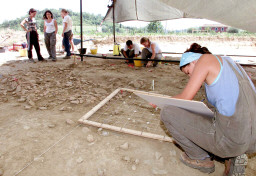
"Prehistoric Venice" Uncovered Near Pompeii


This comes from ANSA.it news:

2006-11-28 18:05
Mythical canal city emerges
'Prehistoric Venice' comes to light near Pompeii
NAPLES (ANSA) An ancient canal city is emerging outside Pompeii, Italian archaeologists say.

Recent digs have unearthed traces of the mythical Sarrasti people, previously known only from Etruscan descriptions.

A large dock has been found, anchored by huge poles and linked to a series of canals dating back to the Middle Bronze Age (2000-1600 BC).

Huts and other wooden structures have been uncovered, perfectly preserved in the age-old mud - making the site unique in Italy.

"We like to call this settlement Italy's 'prehistoric Venice'," said Pompeii archeological superintendent Pietro Giovanni Guzzo.

Archeologists have also found some of the artefacts that made the site at Longola near Pompeii famous in the ancient world, Guzzo said.

"We have oak canoes. We have countless objects carved out of animal horn and bone, as well as bronze and ceramic pieces," Guzzo said, predicting that Longola would "soon have a tourist site all of its own".

The latest object taken out of the soil was a long, strong, tapered pickaxe-like tool.

"This looks like it did a lot of the donkey work at this hard-working, prosperous city," Guzzo said.

"It symbolizes the strength of the Sarrasti," he said, showing the pick to reporters.

The Sarrasti are believed to have dominated the area around the Sarno river until the arrival of the Greeks and Etruscans.

Historians say the city at Longola survived until the foundation of Pompeii in the Sixth Century BC.

The photo comes from the article on ANSA.it

Saturday, November 25, 2006

Holiday Presents


Since here in the US, the holiday shopping season has officially started, I thought I'd offer a few suggestions.

The first is a great present for anyone headed to Italy, especially those going for the first time. Italy: Instructions for Use: The Personal, On-site Assistant for the Enthusiastic but Inexperienced Traveler by Nan McElroy. Nan, according to the book jacket, "has been traveling, eating and living in Italy as often as possible since 1995." (Nan now lives in Venice.)

I have Instructions for Use in front of me as I type this. It's 110 pages of useful information from how do you pronounce things in Italian to shopping and eating. It also has ten tips for the American traveler. My favorite? "Sometimes there's nothing to be done." You can buy the book at Amazon.com or Barnes&Noble.com.

Nan, an American living in Venice, also has a great blog (her latest post describes a pasta-making session).

Can't get enough Venice? Do you really miss it when you're gone? If so, take a look at the photography of Andrea Zanatta (thanks to Nan for turning me onto his work). I agree with the blurb in his book that says he is "one of the most interesting photographers of the young generation in Italy." Put Andrea's book on your Christmas list, or it to your favorite Venice fan. You can buy Andrea's book at Amazon.com.

Who says you can't get good food in Venice? That's a common (misguided) complaint I hear about Venice. Chow Venice: Savoring the Food and Wine of La Serenissima, (Second Edition) makes a great gift for people hunting for good meals in Venice. Co-authors Shannon Essa and Ruth Edenbaum only print reviews of restaurants/bars they've eaten in--and enjoyed. The second edition is due on December 15th--plenty of time to wrap. Order from Amazon.com or Barnes&Noble.com .

Finally, this isn't Venetian, but it's a great taste of Italy. Olio Nuovo, or just crushed olive oil. I can safely post this because my order is already in! If you have never tasted just-crushed olive oil, you're in for a treat. It's like nothing you get in a supermarket! If you'd like to treat yourself or give a really nice gift, check out Casa de Case's website and get your order in fast. [Dec. 13 NOTE: Too late--the olive oil is sold out. And too bad if you missed out because it's wonderful. I've been enjoying mine and I'm not sharing!]


Note: I'm not getting paid by any of these people. I know them (but they don't know I'm posting this) and have enjoyed these things (before I knew them!). I'd be happy to get any of them as a gift and think the Italy/Venice fans in your life would enjoy them too.

Friday, November 17, 2006

Government Says No to Tourist Tax

From WantedInRome.com:

Government scraps proposed tourist tax.
The government has scrapped plans for a tourist tax, which would have allowed Italian towns and cities to add €5 per day to foreign visitors' hotel bills.

The withdrawal of the levy from the 2007 budget was met with relief by both the national and international tourism associations and operators, particularly smaller local companies, who feared that this would have dissuaded foreigners from visiting Italy. Culture and tourism Minister Francesco Rutelli has expressed his support for the U-turn, commenting on the government's “wise decision”.

Italy's most popular tourist destinations, Rome, Florence and Venice, had previously shown support for the proposed tourist tax as a means for improving and maintaining monuments, tourist facilities and services and keeping the cities clean and orderly.

Wednesday, November 01, 2006

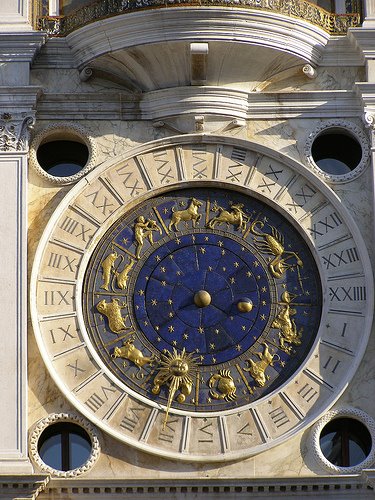
Clock Tower Opens to Visitors!


VENICE: THE CLOCK TOWER REOPENS TO THE PUBLIC
(from AGI) - Venice, Oct. 31 - The Clock Tower reopens to the public and offers - on reservation and with a specialised guide - an extraordinary visit of one hour including a close observation of the complex mechanisms of the clock a splendid view from the balcony on St. Mark square and on the whole city. Upon reservation, the entrance is free of charge for Venetians from 4 to 12 November 2006 at all working hours; from 13 November 2006 to 31 March 2007, upon request, from 4.00 pm. There can be a minimum of 2 and a maximum of 12 visitors. Visits are possible every day (besides 25 December and 1 January) with a fixed schedule. The visit is available only on reservation and with a specialised guide and it covers the five floors of the tower. After the first stairs made of stone the visitor approaches a small room that illustrates the history of the tower. From here it is interesting to observe the interplay of pulleys, weights and counterweights that rise and fall silently at regular intervals. After a winding metal staircase, the visitor approaches the complex Clock Machine. It can be closely observed and an explanation of its principal functions is provided. Another staircase leads to an upper floor where there are wooden statues of the Magi and the Angel, as well as two precious doors from which, on the occasion of Epiphany and Ascension Day, the statues join the procession. From here it is also possible to see the internal mechanism of 'Ta'mbure' of the nineteenth century with the digital indication of hours and minutes. One floor up and the visitor arrives in a room full of ancient objects belonging to the machine, which was made in the 15th century. From here the visitor accedes to two lateral balconies and through yet another winding staircase, to the terrace of the Mori where one can admire huge statues, as well as a splendid vista of Venice and the lagoon."

I'll be in Venice next week for a few days--I hope I'm successful in getting a tour!

The photo is from FlickR.

40th Anniversary of Great Flood Coming Up


November 4th will be the 40th anniversary of the flood that made people pay attention.

"The trouble began on November 4, 1966, when an extremely high tide swept into Venice and refused to leave. For 15 hours, Venice was inundated by the sea. In historic Saint Mark's Square the water was four feet deep. Luckily, no one was killed. But the place was a disaster zone.

"In a single day, the city and the world were forced to face a harsh reality: Venice was sinking into the sea.

"Today flooding has become a fact of life. Instead of floating above the water, the 15th and 16th century buildings are often filled with it, and the ancient bricks are gradually dissolving away." (From Nova, "The Sinking City of Venice)

I took this photo in November 2002. When I took it, the water in San Marco was knee deep. I couldn't imagine what it looked like under 4 feet of water!

The Nova website, Sinking City of Venice, has lots of information on the flooding problem. You can also read the transcript to their show, "The Sinking City of Venice."

The VENETO INSTITUTE OF SCIENCE, LETTERS AND ART in Campo Santo Stefano is going to hold a conference called, "Is There a Future for Venice? Reflections 40 years after the 1966 flood." It will be on Nov. 2 at 10 AM. Contributors include Ignazio Musu, Gherardo Ortalli, Andrea Rinaldo and Wolfgang Wolters.

Sorry for the late notice, but I just found out about it. If anyone attends, please give us a report.

Information, Veneto Institute of Science, Letters and Art, tel. 041.240.77.11. Web site: www.istitutoveneto.it.

Florence will be remembering a different, deadly flood on November 3. "At 5am on November 3, 1966 the skies over Tuscany opened and poured non-stop for 18 hours, causing an unprecedented artistic, economic and human disaster. The River Arno burst its banks, flooded the city and claimed 29 lives.

Mud and water swamped the museums, churches and libraries of the birthplace of the Renaissance, ruining many great works.

The damage caused was incalculable. But it was a fraction of the devastation the city would have suffered without the efforts of thousands of young volunteers who came from all over Italy and from abroad to save the art treasures and help Florence off its knees." (From ANSA.it)

More than 2,000 of those volunteers are scheduled to return to Florence for 100 different events focusing on the flood.

Let's hope these two great cities never face such disasters again!